

What Happens to Your Tax Bracket When Your Spouse Passes Away?
Key Takeaways
- RMDs can leave a surviving spouse with substantial taxable income even after they move from joint to single tax brackets.
- The bridge years between retirement and RMDs are often the best window for couples filing jointly to make Roth conversions.
- Roth conversions can also spare heirs from inherited IRA taxes that come with a traditional IRA.
If you asked married couples what they want their retirement savings to do, most would agree something like this is a top priority:
if anything happens to one of us, the other will be okay, and so will our kids.
Many of these couples save consistently and build healthy IRAs. They stay on top of beneficiary designations and estate documents, too.
They’re doing everything right and feel confident the plan will hold.
Maybe that’s where you are, too.
What plans sometimes neglect, though, is the tax return. Once the surviving spouse moves from joint to single filing, the same IRA you both intended to provide security can push them into a higher tax bracket through required minimum distributions. Higher Medicare premiums may follow.
That’s why you shouldn't wait to plan for the surviving spouse’s tax picture until one spouse is gone. Couples have more options while they’re both here to make decisions together, particularly in the years between retirement and required minimum distributions.
Related Reading:
How to Prepare Financially for the Death of a Spouse
How Your Tax Return Changes After the Loss of a Spouse
In the year a spouse passes, the survivor can generally still file a joint return. That keeps the wider joint bracket and the larger standard deduction intact for one more tax year.
After that, many surviving spouses eventually file as single. A status called “qualifying surviving spouse” extends those joint tax rates for two more years, but only when a dependent child still lives in the home.
(For most couples approaching or in retirement, that exception won’t apply.)
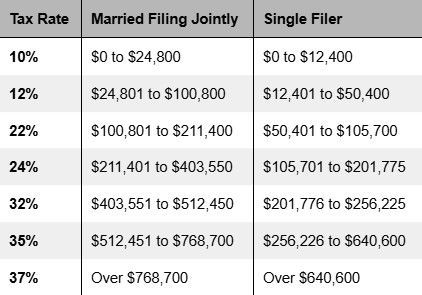
The 2026 federal income tax brackets, updated for OBBB amendments, compare like this:
2026 Federal Income Tax Rates
Source: IRS.gov
How RMDs Hit Harder for Single Filers
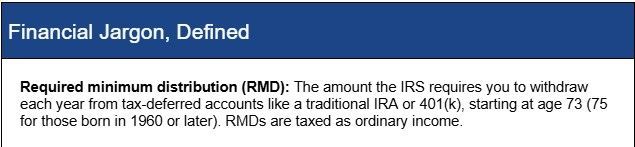
Required minimum distributions can remain a significant source of taxable income after a spouse passes. Meanwhile, household income may not fall all that much. The surviving spouse keeps the larger of the two Social Security benefits, and IRA withdrawals continue as scheduled.
Picture a couple with $260,000 of taxable income after deductions, well within the 24% bracket on a joint return. If the survivor’s taxable income only falls to $220,000, they reach the 32% bracket as a single filer.
Your Options for a Spouse’s IRA
A surviving spouse has more flexibility with an inherited IRA than any other beneficiary. The right choice depends on both spouses’ ages and whether the survivor may need access to IRA funds before age 59 ½.
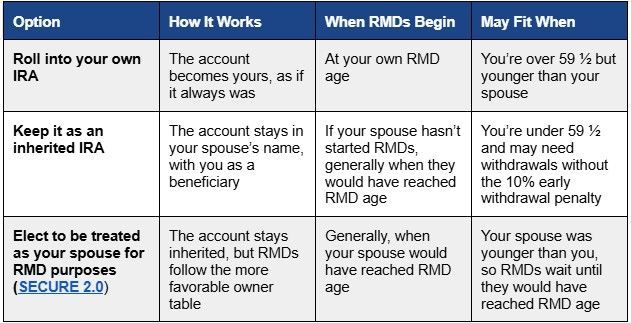
Two points of caution: If your spouse had already started RMDs and hadn’t taken the current year’s distribution when they passed, it generally still needs to come out that year. Additionally, you can't reverse a rollover.
The Bridge-Year Roth Conversion Strategy
Bridge years are the stretch of time between retirement and when RMDs begin (and often before claiming Social Security).
For early retirees, it can be a long window. Many of the public safety professionals we work with retire around 55 and cover living expenses from a 457 plan or pension.
So if Social Security is delayed to 67, that can mean a decade or more of lower-income years. These are the years when many choose to make
Roth conversions.
Each year, the couple would convert enough from a traditional IRA to fill a chosen bracket on their joint return. They pay tax on it that year, but every dollar converted is a dollar that won’t be forced out as a taxable RMD later.
How much should you convert? Consider:
- Medicare premiums.
Conversions count as income, so they can raise IRMAA surcharges two years down the line. Consider those thresholds as much as the tax bracket.
- Paying the tax.
Covering the bill from a taxable account (rather than from the IRA itself) leaves more money to grow tax-free.
- Fit.
If you expect to be in a lower tax bracket later, or if the tax bill would strain your cash flow, it may be better to wait.
- Permanence. Conversions, like IRA rollovers, are not reversible.
Related Reading:
Could a Roth Conversion Raise Your Medicare Bill? What the IRMAA Rules Say
What Your Kids Inherit
So far we’ve focused on the surviving spouse. But eventually, accounts pass to the next generation and the tax picture changes again. Under the SECURE Act, most adult children must empty an inherited IRA within 10 years.
With a traditional IRA, every withdrawal counts as taxable income. For families in this position, inherited IRA taxes can push them into a higher tax bracket during their own peak earning years.
So even when a Roth conversion is somewhat of a tax wash for a couple over their lifetime, legacy can be a reason to do it anyway. Leaving your children Roth money means withdrawals are generally tax-free, and they aren’t required to take annual distributions during the 10-year window.
Planning for This Together
Preparing for the financial challenges of losing a spouse, tax brackets and all, is one of the most practical ways to look after one another and your family.
At
Five Pine Wealth Management, we help couples map out conversion windows and legacy goals as one connected plan. If you’d like help planning for your family’s future financial security, reach out any time to schedule a meeting at
info@fivepinewealth.com or call 877.333.1015.
Frequently Asked Questions (FAQs)
Q: How does remarrying change things?
A:
Remarrying before the end of the year in which a spouse passed generally involves filing jointly with the new spouse instead. A new marriage restores joint brackets going forward, but can raise new questions about beneficiary designations and how assets pass to children from a previous marriage.
Q: Can a trust be named as an IRA beneficiary?
A:
It can. The trust’s wording affects how distributions are timed and taxed, so draft it with your estate attorney and review it alongside your financial plan.
Q: Does living in a
community property state affect our taxable investment accounts?
A:
Potentially. In community property states like Idaho, investments held as community property (such as stocks and funds inside a brokerage account) may receive a full step-up in cost basis on both spouses’ halves when one spouse passes. This can reduce capital gains taxes if the survivor later sells these holdings.
Join Our Newsletter
Plan smarter with our monthly financial tips + insights