

Could a Roth Conversion Raise Your Medicare Bill? What the IRMAA Rules Say
Key Takeaways
- Medicare surcharges (IRMAA) are based on your income from two years earlier, so a decision you make today can raise your premiums well after you've forgotten about it.
- A large IRA withdrawal, a Roth conversion, or selling appreciated assets can all push your income over the IRMAA thresholds, even if the bump is temporary.
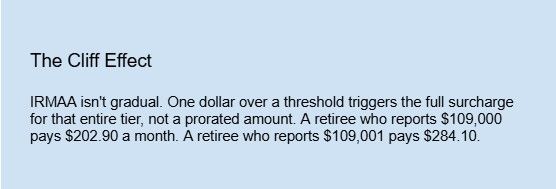
- IRMAA works on a cliff system: crossing a threshold by even a small amount triggers the full surcharge for that tier, not a gradual increase.
You open the mailbox, and there's a letter from Medicare. Your Part B premium is going up, and not just by the usual few dollars. For retirees who saved diligently and built a solid portfolio, it can feel less like a routine adjustment and more like a penalty for doing everything right.
That letter is almost always about IRMAA, the Income-Related Monthly Adjustment Amount. It's one of the more confusing parts of retirement income planning, because the decision behind it could have been made two years earlier, and by the time the bill shows up, most people have already forgotten what caused it.

What is IRMAA?
Medicare Part B and Part D both come with standard monthly premiums. In 2026, the standard Part B premium is $202.90 per person.
But if your modified adjusted gross income (MAGI) is above a certain threshold, Medicare adds a surcharge on top of that base amount for Part B and Part D premiums. The surcharge breaks down into five income tiers.
2026 Medicare Part B Premiums by Income Tier
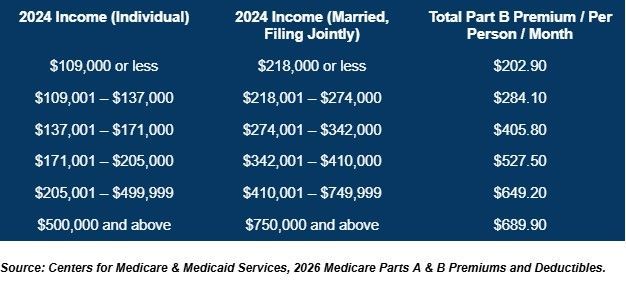
At the top tier, you’re looking at $8,278.80 a year in Part B premiums alone, without Part D surcharges or a spouse’s premium added in.
Who IRMAA Really Affects
IRMAA is aimed at higher-income beneficiaries, which is exactly why it often surprises retirees with substantial savings. Triggering it doesn’t require a high salary, just a high-income year. For retirees drawing from several account types at once, this can happen more easily than expected.
These moves most commonly push MAGI over the IRMAA threshold:
- A large IRA or 401(k) withdrawal. Pulling a big lump sum in one year, maybe to cover a home renovation, a wedding, or a one-time expense, can spike your taxable income for that year by itself.
- A Roth conversion. Converting traditional IRA dollars to a Roth is often a smart long-term move, but the amount converted counts as income in the year it happens.
- Selling appreciated assets. A taxable brokerage account sale that generates a large capital gain adds to your MAGI just as ordinary income does.
- Required Minimum Distributions. Once RMDs begin, they’re mandatory. For retirees with substantial tax-deferred balances, they can be large enough to cross an IRMAA line on their own.
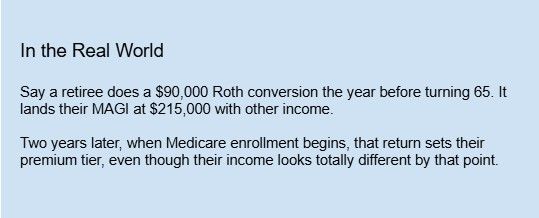
These are ordinary moves that many retirees with $1 million or more make as part of managing their wealth. What trips people up is deciding without checking how it interacts with that two-year reference point.
Planning Around IRMAA Without Overcorrecting
Both conversions and large withdrawals can still make sense, even in years that brush up against an IRMAA threshold, if the long-term benefit outweighs a temporary premium bump. What matters is making that call with full visibility into what it will cost you two years down the road.
That means looking at your income in the context of your full retirement plan, not one account or tax year at a time. A withdrawal that initially seems reasonable in isolation might look different once you factor in Social Security income, a spouse's RMDs, any capital gains already on the books for the year, and how much of that income adds to Social Security taxation for the same year.
Keeping it manageable means:
- Spreading a large withdrawal across two tax years instead of one.
- Timing a Roth conversion for a lower-income year.
- Coordinating the sale of appreciated assets with other income sources already planned for that year.
Having a written plan rather than reacting to opportunities or expenses as they come up makes a real difference. It’s also the same kind of planning that determined
which
account you should pull from first in retirement.
If you haven’t mapped it out yet, our guide on which account to pull from first is a good place to start, since withdrawal order and IRMAA exposure are closely connected.
Five Pine Wealth Management works with retirees moving through this transition and many like it — coordinating Medicare timing with tax and withdrawal decisions so they don’t work against one another.
If Medicare surcharges are something you’re trying to plan around, or you’re not sure how a decision this year might affect your premiums in 2028, let’s talk it through while you still have time to plan for it.
Email us at
info@fivepinewealth.com or call
877.333.1015.
Frequently Asked Questions (FAQs)
Q: I had a one-time high-income year. Can I appeal an IRMAA surcharge?
A: Yes, in certain situations. The Social Security Administration allows you to request a reconsideration if your income dropped due to a qualifying life-changing event, such as retirement, divorce, or the loss of a spouse, and that change isn't yet reflected in the tax return IRMAA is based on. A one-time capital gain or Roth conversion generally doesn't qualify on its own.
Q: Does IRMAA apply separately to each spouse, or is it based on household income?
A: IRMAA is based on your household's MAGI from your joint tax return, but each spouse enrolled in Medicare pays their own surcharge. That means a high-income year raises two premiums if both spouses are on Medicare.
Q: Does a Roth conversion or large withdrawal affect my Social Security taxes too?
A: It can. Social Security taxation uses a measure called provisional income, which adds your other taxable income to half of your Social Security benefit. Those thresholds, $25,000 and $34,000 for single filers, $32,000 and $44,000 for joint filers, haven't changed in decades and aren't adjusted for inflation.
A Roth conversion or large withdrawal that raises your taxable income can also push more of your Social Security benefit into taxable territory that same year.
Join Our Newsletter
Plan smarter with our monthly financial tips + insights