

How Much Can You Spend on Travel and Giving in Retirement?
Key Takeaways
- Having substantial wealth doesn’t automatically translate into a clear strategy for spending on travel, family, and philanthropy.
- A tax-aware withdrawal strategy determines how much you can direct toward discretionary spending and gifts each year without disrupting your plan.
- You can remove the guesswork by giving travel, family gifts, and charitable giving their own funding strategy through tools like donor-advised funds, QCDs, and structured gifting.
- A written, stress-tested income and withdrawal plan is how you get numbers you can act on with confidence.
They call it your “golden years” for a reason. It’s the long stretch you’ve dreamt of for years: leisurely trips with your spouse, helping your kids with a down payment, and finally writing that big check for a cause you’re passionate about.
You built significant wealth and have the resources
and
the desire to do all three. But even with a substantial portfolio, many high-net-worth retirees hesitate before spending freely — even on the things that matter most to them.
Even with substantial assets, they find themselves asking, “How much can I spend in retirement?
That hesitation usually has to do with the absence of a coordinated strategy that spells out how much you can direct toward discretionary spending each year and how those decisions affect your tax obligations, estate plans, and financial flexibility.
Shifting From Building Wealth to Directing It
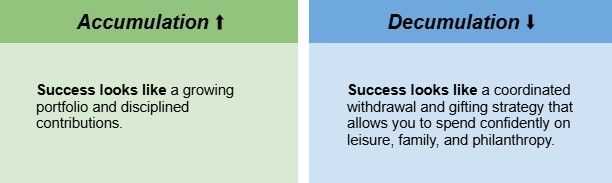
For most of your career, your financial discipline revolved around growing your portfolio: maximizing contributions, managing risk, and watching the number climb.
That habit served you well, but retirement introduces a shift in decision-making. Instead of allocating income toward growth, you’re directing that accumulated wealth toward your lifestyle, your family’s future, and the causes you care about.
Once you retire, your measure of success changes from the size of your balance to whether your withdrawal strategy can fund your priorities and legacy goals without unnecessary tax drag or risk.

Building a Holistic Retirement Withdrawal Strategy
The goal is to build a strategy that shows you how much you can comfortably direct toward travel, family, and giving each year without compromising your long-term financial security.
A rule-of-thumb withdrawal percentage works for a straightforward retirement account, but you’re likely managing multiple account types, concentrated positions, guaranteed income sources, and gifting goals all at the same time.
An effective retirement withdrawal strategy accounts for:
- How your assets are allocated across taxable, tax-deferred, and Roth accounts.
- The order you draw from each account to manage your tax bracket and key income thresholds, like Medicare surcharges.
- What portion of guaranteed income, like a pension or Social Security, covers your baseline expenses.
- How much flexibility you need for market downturns, utilizing a dynamic withdrawal strategy rather than a single fixed percentage.
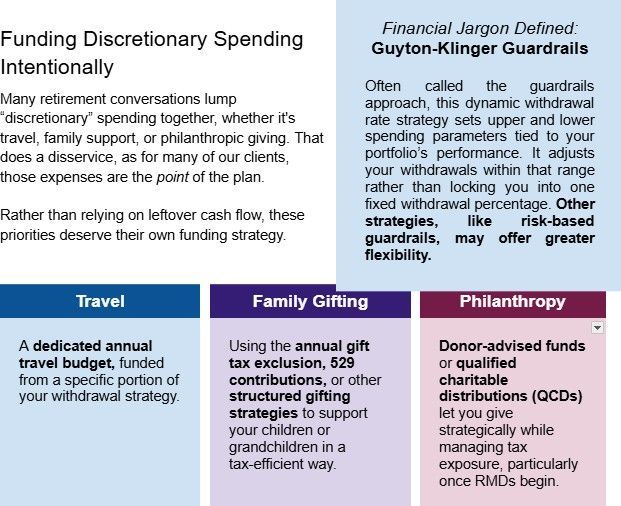
- How travel, family gifts, and philanthropy fit into your annual cash flow as well as your long-term projections.
Some households target a higher rate of spending because guaranteed income covers most of their fixed costs. Others take a more conservative approach if their wealth is more concentrated in a few assets or business interests.
To find the strategy that suits your situation, look at your income sources, expenses, tax exposure, and legacy goals together rather than in isolation.
Related Reading: “Which Account Do I Pull From First?” A Guide to Smarter Retirement Withdrawals
Stress-Testing the Plan So You Can Trust It
Even with a withdrawal strategy in place, it’s fair to wonder what happens if the market has a rough few years right after you retire, or if you end up needing this money for 35 years rather than 25.
A plan you can trust will hold up under these scenarios, not just in best-case projections:
- A market downturn early in retirement. Model a significant drop in year one or two and see whether your planned spending (including travel and giving) still holds without permanently shrinking your future income.
- A longer time horizon. Run the numbers for living to 95 or 100 rather than average life expectancy.
- A large, unexpected liquidity need. Add in an unplanned long-term care need, or having to unwind a concentrated stock or business position at an inopportune moment, on top of budgeted spending to see if your plan can absorb it.
Will your plan still work if everything doesn’t fall into place perfectly? Seeing your travel and giving budget survive a downturn, long life, or unanticipated need helps make it trustworthy.
The Plan Makes Freedom Possible
When clients come to us wanting to travel more or give generously, we build a plan detailed enough that they can see, in writing, exactly how much room they have and that using the wealth they’ve built won’t put other things at risk.
If you’ve built substantial wealth but still hesitate to spend on travel, family, and philanthropy, we’d love to help you craft the plan that creates confidence.
Reach out to us anytime at
info@fivepinewealth.com or call 877.333.1015 to talk through your retirement together.
Frequently Asked Questions (FAQs)
Q: Is it better to give money to family now or leave it to them in my estate plan?
A: There’s no universal answer. Giving during your lifetime allows you to see the impact of your gift and may be useful as part of a broader estate strategy.
However, the tax implications can differ depending on the size and type of gift, your estate, and the assets involved. Consider lifetime gifting alongside your own spending needs, tax strategy, and legacy goals.
Q: Should charitable giving change once I start taking Required Minimum Distributions (RMDs)?
A: For many retirees, yes. Once RMDs begin, a qualified charitable distribution can allow you to send money directly from your IRA to a charity, which can satisfy a portion of your RMD while reducing taxable income.
Q: Should I plan to spend more on travel in my early retirement years rather than later on?
A: Many retirees do. Travel and other physically active pursuits tend to work best when you have the health, mobility, and energy. A withdrawal plan can account for “front-loading” rather than assuming flat travel expenses across every year of your retirement.
Join Our Newsletter
Plan smarter with our monthly financial tips + insights